By Fjóla Dögg Helgadóttir, PhD, R.Psych.

When I started my PhD in 2007 at the University of Sydney, I was lucky enough to have Professor Ross Menzies as my supervisor. I had already completed 2 university degrees in psychology (I now have 4), but my scholarship did not come with a budget for technical development, so I decided to learn PHP and MySQL and code the program myself. That meant I could write both the clinical content and the technical architecture from the ground up. During my PhD, I built an online program for stuttering, drawing on Dr. Menzies’ existing group-based CBT work in that area. That experience taught me how to think about translating structured clinical content into adaptive, individualised delivery online, and it planted the seed for what I would go on to build independently. In 2012, I co-founded AI-Therapy with Dr. Neil Yager, and Neil and I own the company. Together we built Overcome Social Anxiety entirely from scratch, with Professor Ross Menzies co-authoring and owning 50% of the clinical content in that program.
At the time the term “artificial intelligence” still evoked chess-playing computers and academic papers more than existential dread. We called the program AI-Therapy because it genuinely described what we had built: a system that used the logic of artificial intelligence, adapting dynamically to each user, to deliver evidence-based Cognitive Behavioural Therapy. The name felt accurate, a little futuristic, and kind of exciting.
That was then.
What AI-Therapy Actually Is
Let me be specific, because specificity matters more than ever right now.
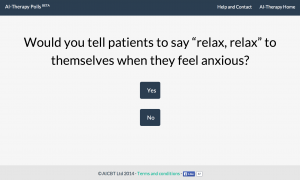
AI-Therapy is a pre-written, clinician-developed CBT program. Every word of therapeutic content was written by us, researchers and clinicians with decades of combined expertise in anxiety treatment. There are no words generated on the fly. There is no large language model producing responses. There is no chatbot waiting to say something reassuring (or, as has been widely reported with other AI tools, something harmful).
What makes it “AI,” in the original sense of that word, is the adaptive logic underneath. The program responds to what you tell it about yourself: your specific feared situations, your avoidance patterns, your safety behaviours. It selects, sequences, and tailors the therapeutic content accordingly. You and the person sitting next to you could both complete AI-Therapy for social anxiety and have meaningfully different experiences, because the program is responding to each of you individually.
This is what personalised, algorithmic delivery of therapy looked like before anyone was talking about chatGPT. It is also, I would argue, what responsible digital mental health looks like: structured, grounded in clinical theory, pre-approved by the people whose names are on it, and unchanging in a way that can actually be studied.
The Evidence Base
After more than a decade, we can now say with confidence: this approach works.
AI-Therapy has 13 peer-reviewed publications behind it, including a randomized controlled trials. The program has demonstrated an effect size of approximately 1.76. For context, most face-to-face CBT programs for social anxiety show effect sizes in the range of 1.0 to 1.5. The effect size we see reflects both the potency of the underlying CBT protocol, developed by Ross and I building on decades of clinical research.
Since launching Overcome Social Anxiety in 2012, the platform has continued to grow. Overcome Fertility Stress followed in 2015, offering structured CBT support for people navigating the psychological burden of infertility. As of May 2026, we can finally say that this program is also evidence-based, following the publication of our randomized controlled trial in the Scandinavian Journal of Psychology, which found a large effect size of 1.7. What was particularly interesting was that we also found fertility-stress-specific effects, suggesting that the program addresses the unique psychological challenges associated with infertility, beyond general improvements in psychological distress.
Overcome Death Anxiety launched in 2019 and is currently being studied in a formal research program at the University of Sydney, led by Dr. Rachel Menzies.
Each program follows the same philosophy: pre-written, clinician-developed content, delivered adaptively. Each has been built to be studied, not just used right away.
What AI-Therapy Is Not
I want to be clear about this, because the landscape has changed so dramatically.
AI-Therapy is not a large language model. It does not generate text. It cannot say anything I have not already written and approved. It does not learn from your data in the way that modern AI systems do. It does not have plans to add a conversational AI layer in any way that compromises clinical integrity. What we are actively exploring is how to increase adherence, keeping people engaged with the structured content that we know works. It is not a wellness app. It is not a chatbot with a calming colour palette. It is a treatment tool.
This distinction matters, both clinically and ethically. One of the most significant concerns raised about LLM-based mental health tools is the risk of unpredictable outputs: a system that might say something clinically contraindicated or respond to a disclosure of suicidality in a way that no responsible clinician would endorse. That risk simply does not exist in a pre-written system. What you read is what we wrote. We stand behind every word of it.
The Name Problem
Here is the uncomfortable part.
We are living through a period of significant, and in many ways justified, scepticism about AI. People are worried about job displacement, about misinformation, about companies rushing products to market without adequate safety testing. Mental health is a particularly sensitive domain, and the news has not been short of stories about AI therapy tools behaving in troubling ways.
Into this climate walks a program called “AI-Therapy,” which has been around since 2012 and has nothing to do with any of those concerns, but whose name now lands very differently than it once did.
I will be honest: if we were naming this program today, we might choose differently. Not because we are ashamed of the technology, but because the word “AI” now carries associations that do not describe what we built. When someone hears “AI therapy” in 2026, they are almost certainly picturing a chatbot, a generated response, something that a tech company spun up last quarter. They are not picturing anxiety researchers at the University of Sydney writing careful, structured CBT modules over many years and then building adaptive logic to deliver them.
The irony is that the name was always accurate. We used artificial intelligence, in the classical sense, to personalise therapy. We were doing this before it was fashionable, and arguably we were doing it more carefully than most of what has come since. The name was ahead of its time. Now it is, in a different way, out of step with its time.
Why I Am Not Changing It
I have thought about this more than once. And I keep coming back to the same conclusion: the answer is not to retreat from the name, but to explain it.
Changing the name would feel like a concession to a misunderstanding. It would suggest that there is something about AI-Therapy that should concern you, when in fact the opposite is true. This program represents what careful, evidence-based digital mental health intervention looks like. It was built by clinicians, tested in randomised controlled trials, and refined over nearly two decades. It uses technology to extend access to effective CBT, not to replace clinical judgment with a system that cannot be held accountable.
The conversation worth having is not “should we distance ourselves from AI?” It is “what does responsible use of technology in mental health actually look like?” And I think AI-Therapy, the original one, the pre-written, personalised, evidence-based one, has always been a reasonable answer to that question.
If you have questions about how the program works or want to understand more about what makes it different from the wave of AI-powered mental health tools making headlines, I am genuinely glad to talk about it. The nuances matter, especially here.
Fjóla Dögg Helgadóttir, PhD, R.Psych., runs a practice in Vancouver, BC, where she practices evidence based psychology for variety of psychological problems www.drfjola.com and is a co-creator of AI-Therapy (www.ai-therapy.com). The platform includes Overcome Social Anxiety (2012), Overcome Fertility Stress (2015), and Overcome Death Anxiety (2019), the latter currently under research at the University of Sydney led by Dr. Rachel Menzies. Dr. Fjóla is an active CBT researcher who collaborates with universities around the globe and has published extensively in the field, and is Past President of the Canadian Association of Cognitive and Behavioural Therapies.